
The custom audit module lets you build, distribute, and score audit templates for a wide range of internal and external purposes, such as:
- Vendor screening
- Vendor assessment
- Vendor security assessment
- Data Privacy and Protection Assessment
- DPIA (Data Protection Impact Assessment)
- PIA (Privacy Impact Assessment)
- Internal policy compliance checks
- And much more...
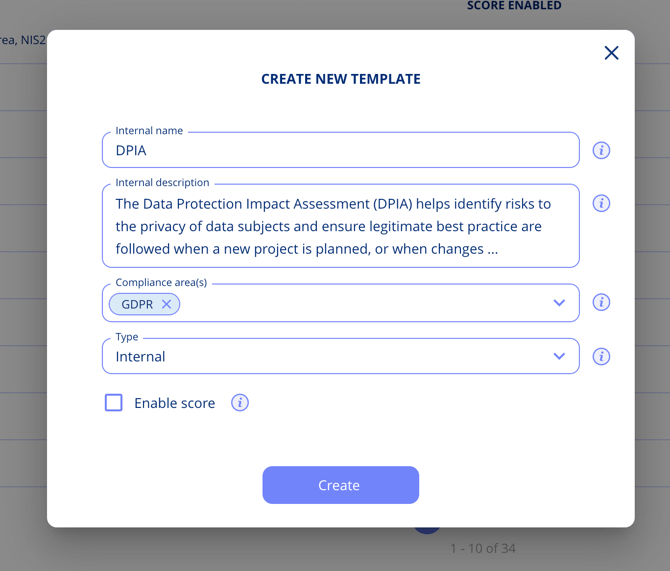
To create a new audit template go to Settings > Visit audits. Now choose “Create new template”. Provide a template name, a template description (optional) and specify the compliance areas that the audit should cover (optional). Select whether the intended usage of the template is for internal use within your company or for distribution to external parties. Lastly, specify whether the template should include a score based on the recipient’s responses. You can read more how to create an audit with score here: Create audit with score.
After creating the template, add a title and description to your audit. Both fields will be visible to the recipient.
You can also create a copy of an audit you previously created. To copy an audit, open the audit template list, click the options menu (three dots) next to the template, and select Copy. The copied template will include all questions, branching logic, sections, and other design settings from the original.
Questions
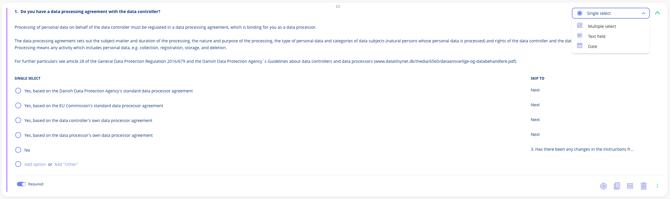
Each question consists of an autogenerated number, a title, an optional description, and a question type. When adding a question, choose from the following question types:
- Single select: Respondents can select one answer from the list of answer options (selected by default)
- Multiple select: Respondents can select multiple answers from the list of answer options
- Text field: Respondents can write a text response to your question
- Date: Respondents can enter a specific date
- File upload: Respondents can upload a file
You can switch the question type using the dropdown menu to the right of the question text.
Add a new question by clicking the button "New question" at the bottom of the page or click the plus icon within a question. If you click the button the new question will appear at the bottom of the page, while clicking the plus icon will insert the new question right below the one you have inserted it from.
Sections
If you have a long survey, you can break it into multiple sections. The section function helps you to organize the audit, so it is easier for the respondent to answer and get an overview of the audit structure. A section therefore consists of one or more questions. Questions in the same section will appear on the same page in the respondent view. Furthermore, you have the option to choose a different colour for each section.
Add extra options to a question
Click the options menu (three dots) in the bottom right corner of any question to access the following options:
- Description: Adds a description field below the question title, visible to the respondent.
- Add comment: Allows the respondent to add an optional comment to their answer.
- Recommendation: Adds a Recommendation column. If a respondent selects an answer option that has a recommendation, that recommendation appears in the audit report.
Add branching logic (Single select)
You can also add branching logic to your audit. Branching is a functionality that changes what question a respondent sees next based on how they answer the current question. The branching creates a custom path through the audit that varies based on a respondent's answers. You can make branches to questions within the same section or to the first question in another section. To add branching to a question:
- Click the options menu (three dots) in the bottom right corner of the question.
- Choose Add branching. A new Skip to column will appear.
- For each answer option, choose the question it should skip to.
Manage questions
Use the following actions to manage questions after adding them:
- Move a question: Click and drag the question to the desired position in the audit. If the question has branching logic applied, test the logic paths thoroughly before sending the audit. If you move a question so that an answer option skips to a previous question, the branching logic will not be applied and a warning will appear.
- Required question: Make a question required so respondents must answer it before submitting the audit. To mark a question as required, click the options menu (three dots) in the bottom right corner of the question and toggle on Required. Required questions are marked with an asterisk (*) by default.
- Copy question: Creates a duplicate of the question directly below the original. Branching logic from the original carries over to the copy.
- Delete question: Click the question and then the trashcan icon. Deleted questions cannot be restored.
Next up
Before publishing, preview and test your audit to verify it appears and functions as intended. For detailed instructions, see: Preview, test and publish audit.
You can also get to know more about audit administration here: Administration of audits.